

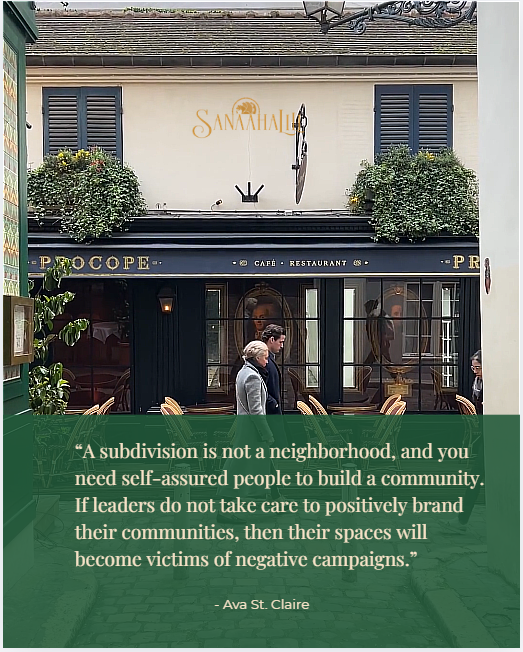
A subdivision is not a neighborhood
With economic development in urban communities, the psychology of safety and security can be even more powerful than the reality of safety and security. In this day and age of digital propaganda, cities, neighborhoods, and even countries have become products and can be branded as such. If community leaders choose not to brand their product, it is susceptible, like any other product, of being branded by the competition.
Even when statistics state that you’re safe in most situations most of the time, if you *feel* unsafe, then you are in fact not safe. Given the highly competitive nature of urban spaces, if the stewards of these places do not take care to positively brand their communities, then the competution will make them victims of negative campaigns.
This can manifest itself in two different ways:
If a resident feels they are not safe, they won’t patronize businesses or public spaces in their own neighborhood. They will carry on with their business in a neighborhood that has been *branded* better or *feels* safer.
When a business owner feels unsafe, they will do things to their business that will cause the business to perpetuate a sense of insecurity. Of course, this only confirms suspicious residents that the business is in fact unsafe.
It is important for leaders to be aware of this psychology and use design as a tool to create a feeling of safety, security, stability, and optimism. Educate business owners on the statistics, address actual needs, and give them the tools they need to thrive beyond the feelings of insecurity.